
A review of The Poetics of Dimensions exhibition at Institute of Contemporary Art San Francisco. I initially wrote this to submit to Burlington Contemporary Art Writing contest but since it wasn’t selected as a winner for that, I thought I’d go ahead and share it here.
I’ve spent years interviewing artists about how they transform difficulty into work. How chronic pain shapes what medium they choose. How displacement changes what stories they can tell. How depression alters their relationship to productivity. This research, my Six-Part Creative Health Framework, maps the ways health impacts every dimension of creative practice.
So when I walked into The Poetics of Dimensions at ICA San Francisco, I recognized something familiar in the work, even though I’d never seen most of these artists before. Here were eleven artists doing what artists have always done: taking what’s broken, abandoned, exhausted, or discarded and metabolizing it into something that insists on being seen.
Curated by Larry Ossei-Mensah, the exhibition gathers plastic bags, shoelaces, worn fabrics, and bottle caps (the overlooked remnants of contemporary life) and subjects them to acts of careful metamorphosis. But this isn’t a feel-good story about recycling or redemption. These artists treat salvage as a mode of memory, witness, and repair. The ruins of global production are neither purified nor redeemed; they’re composted into unstable, fragile forms of survival.
Which is to say: this is an exhibition about how we keep going when purity is no longer an option.
The Unopened Loop: Anthony Akinbola’s Fantasy World
The exhibition opens with deliberate friction. Fantasy World (2023), a claw machine by Anthony Akinbola, gleams under bright lights. Plastic trinkets and plush toys sit sealed in cellophane promises. The machine is untouched, its surface sterile.
Positioned at the entrance, it stages the unbroken loop of consumption: a closed system in which acquisition is stripped of consequence. In a show devoted to transformation, Akinbola’s untouched ready-made functions as a foil. Without intervention, the cycle of desire remains intact. The viewer is implicated from the start.
If Fantasy World frames the problem, the works that follow metabolize it with varying degrees of resistance.
The Weight of Waste: Hugo McCloud’s Material Witness
A bowed figure, stitched from fused strips of polypropylene plastic, staggers under the weight of a green bundle in retirement (2020) by Hugo McCloud. The material, sourced from the waste streams of Mumbai, Morocco, and the Philippines, retains its glossy, toxic sheen.
McCloud’s surfaces refuse romanticization. The plastic doesn’t pretend to be anything other than what it is: refuse from global capital’s digestive system. In my interviews with artists working with salvaged materials, they often describe a responsibility to the material’s history. McCloud honors that responsibility. His surfaces insist that the detritus of global capital is both medium and message, inseparable from the invisible economies that produced it.
The figure carries its burden. The plastic carries its history. Neither is resolved.
Landscapes of Exhaustion: Rodney McMillian’s Hardened Intimacy
The residue of labor permeates Rodney McMillian’s Untitled (Orange Hills) (2022–23), where a stiffened bedsheet, hardened with poured latex paint, becomes an inhospitable landscape. Ochre, green, red, and black bands accumulate like geological strata, their surface resisting touch and offering no refuge.
This strikes me as one of the most devastating pieces in the show. A bedsheet (a site of intimacy, of sleep, of rest) transformed into an abstraction of exhaustion. In McMillian’s hands, the domestic object becomes terrain. The work reads as an elegy for spaces eroded by environmental degradation and systemic neglect, a silent topography where the body has already been expelled.
When I think about my Creative Health Framework’s dimension of “Creative Process” (how health conditions shape the physical act of making), I think about artists like McMillian who make exhaustion visible. Who turn depletion itself into subject matter.
Unraveling Identities: Sonia Gomes and the Provisional Self
A suspended sculpture by Sonia Gomes, Um lugar, um corpo (A Place, a Body) (2014), entangles textiles around a birdcage-like form. Threads spill and snake along the floor. The fabric, drawn from varied sources, retains traces of prior use, embodying memory without cohering into a singular narrative.
Identity, like cloth, appears stitched, provisional, and prone to unraveling.
This resonates with what artists navigating chronic illness or disability often describe: the self as constantly reconstructed, held together by tenuous threads, always at risk of coming apart. Gomes’s sculpture doesn’t offer wholeness. It offers the honest complexity of being assembled from fragments.
Rewoven Ambitions: Miguel Arzabe’s Cultural Metabolism
From a distance, a woven surface shimmers with intricate black, white, peach, and red geometries. Its tight warp and weft suggest tradition more than disruption. Only on closer approach does it disclose its composition: shredded paper strips, salvaged from discarded Bay Area art-event posters, laboriously rewoven by Miguel Arzabe into Last Weaving (2018).
This piece delights me. Arzabe takes the promotional debris of the art world (those glossy announcements of openings and exhibitions that pile up and get thrown away) and metabolizes them into something painstaking and beautiful. He unsettles the idea of autonomous creativity, treating residue not as failure but as generative material for new, fragile continuities.
There’s something here about sustainability in creative practice, about what we do with the exhausted promotional cycles, the projects that didn’t land, the work that gets overlooked. We can compost it. We can weave it into something else.
Compressed Histories: Shinique Smith’s Bale Variant No. 0014
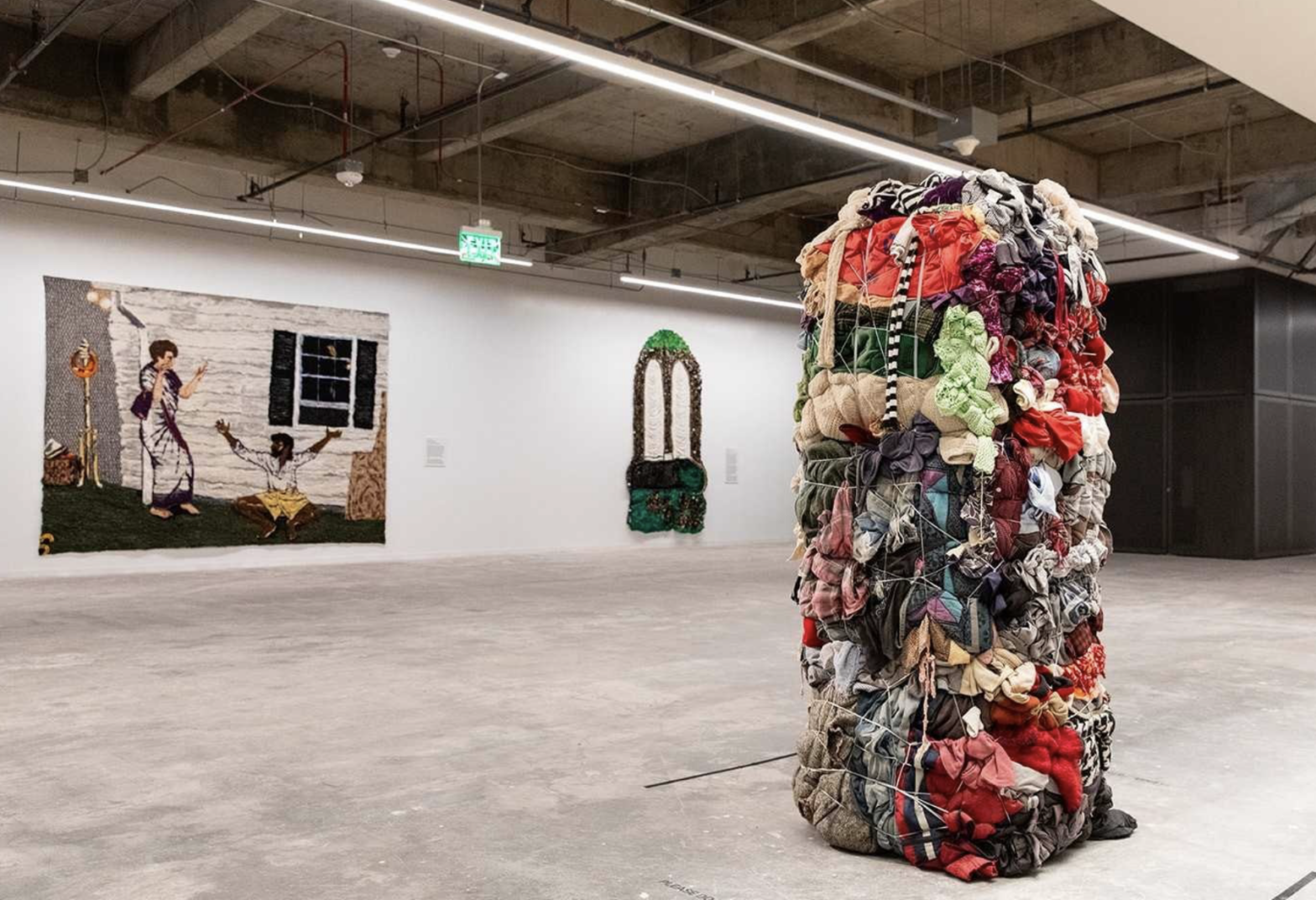
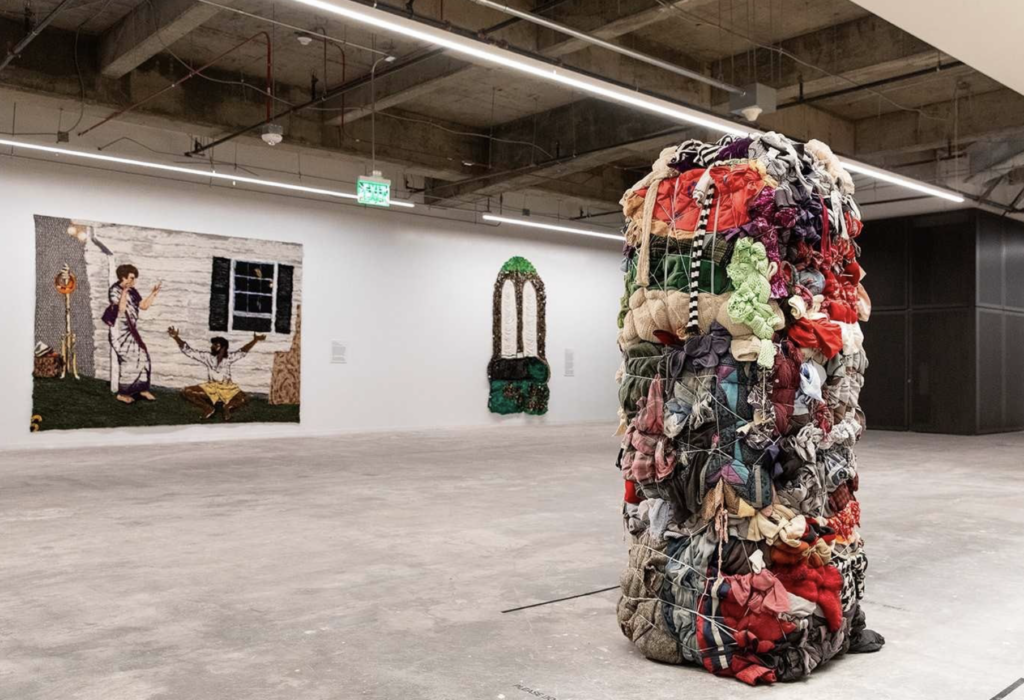
The notion of collective accumulation turns heavier, almost unbearable, in Shinique Smith’s Bale Variant No. 0014(2008). Garments sourced from personal and familial histories are compressed into a dense, rope-bound mass. Denim, lace, and silk collapse into an anonymous anthropomorphic body, their colors muffled under the pressure of containment.
The bale’s apparent solidity belies its tension. Threads strain at the surface, hinting at imminent rupture. Here, memory and violence are coiled together, inseparable, poised between endurance and collapse.
This is what unprocessed trauma looks like: bound tight, compressed, held together by sheer force. The body straining against its own containment.
Fraying Memory: Nari Ward’s The Martyrs of the Race Course
Memory itself falters nearby. A sagging script stitched from shoelaces clings uncertainly to the wall. The Martyrs of the Race Course (2023) by Nari Ward commemorates a little-remembered ceremony in Charleston, where emancipated Black Americans honored Union soldiers buried in unmarked graves.
The shoelaces droop and fray, rendering the words unstable, vulnerable to the pull of gravity. In Ward’s work, remembrance is a fragile tether, stretched thin across time, subject to the same forces of erasure and exhaustion that haunt the materials throughout the exhibition.
I think about the artists I’ve interviewed who carry family trauma, historical trauma, collective grief. How do you make work that holds that weight without breaking? Ward’s answer: you make the fragility visible. You let the memorial sag. You show the work it takes to remember.
The Unresolved Contradiction
The Poetics of Dimensions does not evade its own contradictions. Originally conceived for a commercial context at Art Basel Miami Beach, the exhibition inevitably participates in the circuits of commodification it critiques. The transformation of discarded matter into collectible artworks risks aestheticizing the very structures of extraction and abandonment that it seeks to expose.
The friction between critique and participation remains unresolved. And appropriately so.
Rather than offering solutions, the exhibition inhabits the ambiguous space between complicity and resistance. Its strongest works metabolize debris not into monuments but into precarious, provisional forms. These are not acts of redemption, but of persistence. Not erasures, but accumulations.
Against the gleaming sterility of the claw machine, the artworks propose an alternative metabolism: one that is slower, imperfect, and unfinished.
What Artists Do With Waste
In the end, The Poetics of Dimensions assembles not a grand narrative but a constellation of afterlives. It asks what remains possible when purity is no longer an option, when survival itself becomes an act of continual reassembly.
This is the question at the heart of my Creative Health work: How do artists keep making when they’re working with broken materials (including their own bodies, their own histories, their own exhausted systems)? How do they transform what capital discards? How do they witness what systems render invisible?
The artists in this exhibition don’t provide easy answers. They show us the work itself: the stitching, the weaving, the compressing, the metabolizing. They show us that transformation is not purification. That survival is not redemption. That making art from waste (whether material waste or the waste of our own depleted selves) is an act of witness, not transcendence.
The answer, necessarily incomplete, unfolds not in triumph but in fragile, material acts of remembrance. And that, I think, is enough.