
Creating space for healing and expression through community arts programs is powerful work. But when your participants have experienced displacement, violence, systemic oppression, or other forms of trauma, the stakes are even higher. The way you design and facilitate these programs can either create safety and possibility, or inadvertently cause harm.
I’ve spent the past several years co-founding and coordinating In My Fluffy Pajamas, a series of trauma-informed arts workshops in San Francisco serving immigrant and refugee communities. Working alongside Iranian-born artist Badri Valian, we’ve facilitated multilingual programs (in Mandarin, Spanish, and Farsi) at cultural centers across the city, engaged over 10,000 participants at public events, and secured more than $45,000 in grants from organizations including the San Francisco Arts Commission and the Asian Pacific Islander Cultural Center.
Through this work, I’ve learned that trauma-informed arts programming isn’t just about what activities you offer. It’s about how you build partnerships, how you design your space, how you communicate, and how you hold complexity when people share stories that don’t fit into neat narratives.
This guide walks you through the essential steps for designing and coordinating trauma-informed community arts programs, from initial planning through evaluation. Whether you’re working with survivors of violence, immigrant communities, people experiencing homelessness, or any group navigating significant adversity, these principles can help you create programs that honor people’s experiences and support genuine healing.
Understanding Trauma-Informed Practice in Arts Contexts
Before diving into the how-to, let’s clarify what we mean by trauma-informed arts programming.
Trauma-informed practice recognizes that many people have experienced events that overwhelm their capacity to cope. These experiences shape how people move through the world, how they relate to others, and how they respond to stress. A trauma-informed approach doesn’t require people to disclose their trauma or focus on traumatic events. Instead, it creates conditions where people feel safe enough to be present, make choices, and engage authentically.
In arts programming specifically, this means:
Understanding that creative work can be activating. Making art asks people to be present in their bodies, access emotions, and sometimes confront difficult material. For someone with trauma history, this can feel overwhelming or unsafe.
- Recognizing that safety is foundational. People can’t engage meaningfully in creative work if they’re in survival mode. Your program design needs to prioritize physical, emotional, and cultural safety.
- Centering choice and agency. Trauma often involves loss of control. Trauma-informed programs restore agency by offering choices at every step.
- Acknowledging power dynamics. As a program coordinator, you hold power. Being trauma-informed means being transparent about that power and sharing it wherever possible.
In my work coordinating In My Fluffy Pajamas workshops at the Chinese Culture Center, Mission Cultural Center for Latino Arts, and other San Francisco venues, I’ve seen how trauma-informed approaches allow participants to engage more deeply. When people feel safe, they share stories they’ve never told. When they have choices, they experiment with materials they might otherwise avoid. When facilitators acknowledge power dynamics, participants step into leadership.
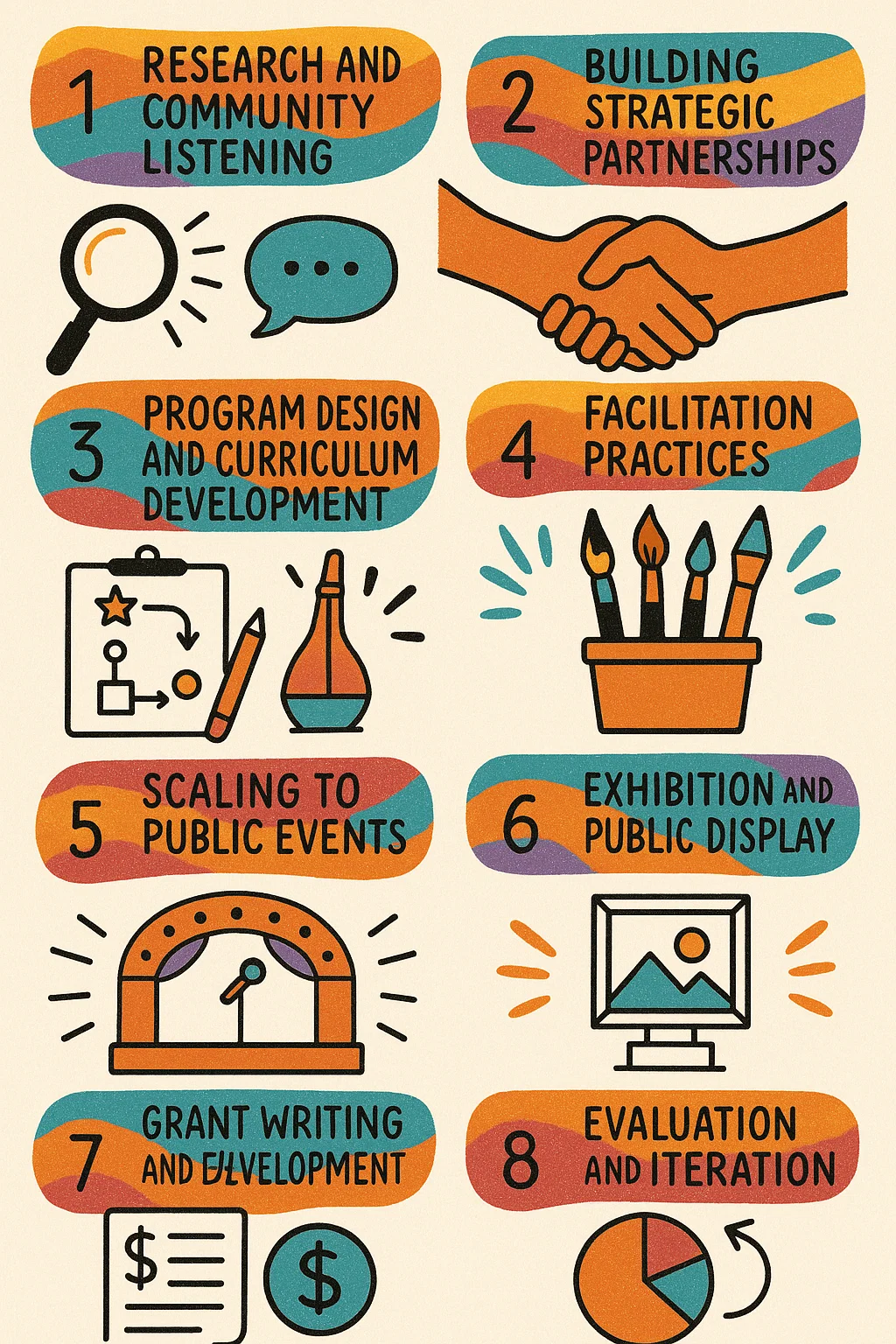
Step 1: Research and Community Listening
Trauma-informed arts programming starts long before the first workshop. It starts with listening.
Know the Community You’re Serving
Before designing any program, invest time in understanding the community. What are their experiences? What strengths do they bring? What barriers might they face in accessing arts programs?
When Badri Valian and I began developing In My Fluffy Pajamas, we didn’t start with a workshop plan. We started with conversations. We talked with others about what their communities needed. We learned about the specific challenges facing immigrant communities in San Francisco – language barriers, economic precarity, isolation from family and cultural networks, experiences of discrimination. Badri is an immigrant from Iran and we spent many hours talking about her experiences as compared to my experiences as an American-born woman, exploring the similarities and differences.
We also learned about strengths: rich cultural traditions of textile work, deep storytelling practices, strong community bonds, and resilience in the face of adversity.
This research phase included:
- Conversations with community leaders and organization staff. They understand their communities far better than any outsider can.
- Learning about relevant cultural practices. Understanding how different cultures approach art-making, storytelling, and collective gathering informed our workshop design.
- Understanding systemic barriers. What keeps people from participating in arts programs? Cost? Transportation? Language? Childcare? Immigration status concerns?
- Identifying existing community assets. What cultural centers, mutual aid networks, or community organizations already serve this population? How can you work with them rather than duplicating efforts?
Identify Gaps and Needs
Through this research, you’ll start seeing where needs aren’t being met. In our case, we found that while many programs served immigrant communities, few combined trauma-informed approaches with culturally specific arts practices. Few offered multilingual facilitation. Few centered stories of displacement and resilience in ways that honored complexity rather than reducing experiences to simple narratives.
These gaps became our program focus.
Step 2: Building Strategic Partnerships
Trauma-informed community arts programs can’t exist in isolation. You need partners who bring community trust, cultural knowledge, and practical resources.
Choose Partners Aligned with Your Values
In my experience managing over $45,000 in arts grants and coordinating programs across multiple sites, partnership quality matters more than partnership quantity. Choose organizations that:
- Share your commitment to trauma-informed practice. If a potential partner doesn’t understand why offering choices matters or why you can’t rush people through activities, they’re not the right fit.
- Have established community trust. When the Chinese Culture Center invited us to facilitate at 41Ross in Chinatown, participants came because they trusted the Center. We were strangers. The Center’s endorsement created safety.
- Bring cultural knowledge and language capacity. You cannot do trauma-informed work with immigrant communities without linguistic and cultural accessibility. Full stop. Working with Mission Cultural Center for Latino Arts, we partnered with Spanish translators who understood not just language but cultural context.
- Have infrastructure to support programs. Do they have appropriate space? Can they help with promotion? Can they assist with logistics like materials or refreshments?
Establish Clear Roles and Communication
Once you’ve identified partners, clarify who’s responsible for what. In our partnerships, we typically:
- Co-design program content with partners. Their cultural knowledge shapes what activities we offer and how we frame them.
- Divide logistical responsibilities. Partners usually handle space, promotion to their communities, and day-of logistics. We handle curriculum, materials, facilitation, and grant reporting.
- Create regular check-in structures. Before each workshop series, we meet with partner staff. After each session, we debrief. This ongoing communication helps us adjust in real-time.
- Acknowledge power dynamics explicitly. As grant recipients, we hold certain power. We name this and actively work to share decision-making with partners who know their communities better than we do.
Step 3: Program Design and Curriculum Development
Now comes the creative work of designing your actual program. Trauma-informed curriculum balances structure with flexibility, offers clear frameworks while leaving room for emergence.
Core Design Principles
Every program is different, but these principles guide trauma-informed design:
- Start with grounding and orientation. People need to know what to expect. We always begin workshops by explaining what we’ll do, how long it will take, and what choices people have. We also include a brief grounding activity—often as simple as noticing breath or feeling feet on floor.
- Offer multiple entry points. Not everyone relates to art-making the same way. In My Fluffy Pajamas workshops combine textile work, mapmaking, drawing, and storytelling. Participants can engage with one or all. Some people work better with structured prompts. Others need open-ended exploration. Offer both.
- Make everything optional. People can participate without sharing. They can share without going deep. They can step out if they need a break. We say this explicitly: “You’re in charge of your own experience here.”
- Build in choice at every level. Choice of materials, choice of how much to share, choice of working alone or in groups, choice of whether to display finished work. Every decision point is an opportunity to restore agency.
- Pace slowly. Rushing triggers stress responses. We structure workshops with generous time. If something takes longer than planned, we adjust. Participants’ pacing matters more than our schedule.
- Integrate cultural responsiveness. In workshops with Chinese Culture Center, we learned about traditional Chinese knotting techniques and incorporated them. At Mission Cultural Center, we explored textile traditions from Latin America. Honoring cultural practices creates belonging and safety.
Example Curriculum Structure: In My Fluffy Pajamas Workshop
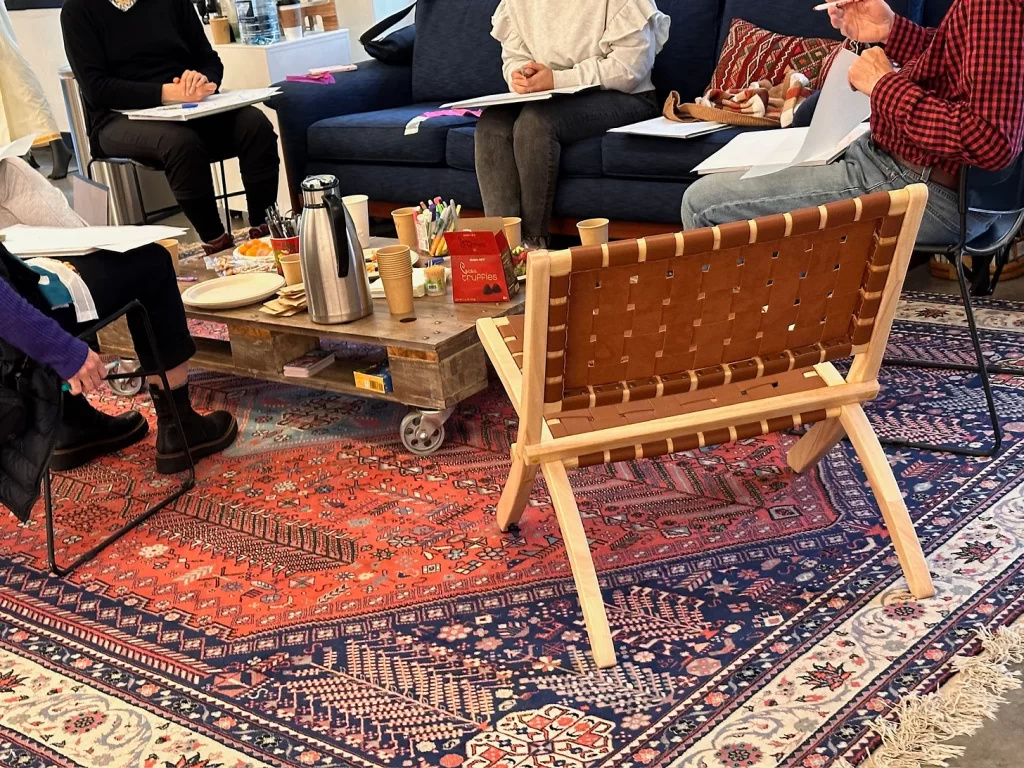
Here’s how we might structure a typical three-hour In My Fluffy Pajamas workshop:
Opening Circle (20 minutes)
- Welcome and introductions, translated into all languages present (Mandarin, Spanish, Farsi, depending on the workshop iteration)
- Overview of what we’ll do today, with time built in for translation
- Establishing group agreements co-created with participants
- Grounding and breathing exercises to help participants connect with their bodies and establish a sense of safety before engaging with potentially difficult memories
Introduction to Theme and Cultural Context (15 minutes)
- Present historical and cultural context relevant to the specific community. For example, in APICC workshops, we share stories of immigrant women from San Francisco’s Chinatown history, with handouts featuring biographies in English, Mandarin, and Spanish. In California Arts Council workshops serving Farsi and Arabic speakers, we discuss connections to Silk Road traditions and shared histories of displacement.
- Explain how today’s art-making connects to these larger themes
- Show examples of finished pieces from previous workshops, not as models to copy but as possibilities for what participants might create
Materials Exploration (15 minutes)
- Introduce available materials: fabrics carefully selected to reflect traditional patterns and colors from participants’ countries of origin, transparent paper for layered mapmaking, markers, yarn, and other textile materials
- Demonstrate basic techniques for working with fabrics and creating layered maps
- Encourage participants to touch and explore materials before starting their own work
- Answer questions about the process
Sensory Recall and Cultural Memory (20 minutes)
- Guide participants through sensory recall exercises, asking them to reflect on memories of their homeland through the five senses
- Prompts include: What foods did your ancestors love? What plants did your ancestors love? What smells, sounds, or clothing connect you to your cultural heritage?
- These reflections become the foundation for the visual art participants will create
- No requirement to share these memories aloud; participants can keep them private
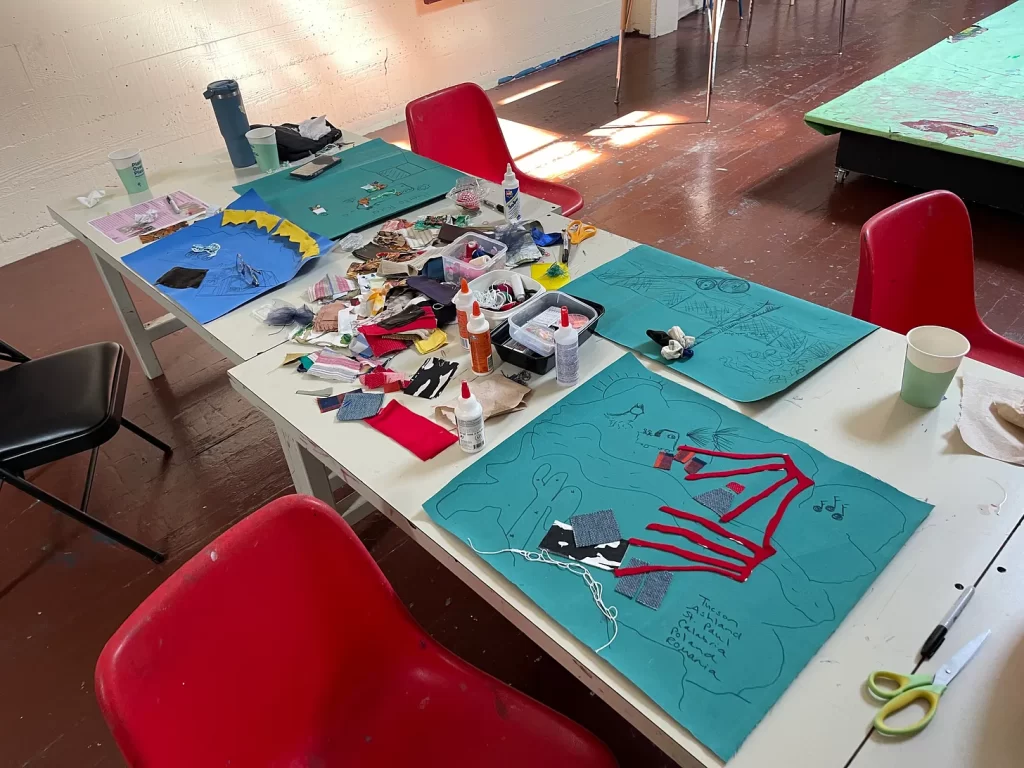
Open Work Time: Creating Layered Maps (70 minutes)
- Participants create double-layered maps visualizing their migration journey
- Using transparent paper overlays combined with fabric pieces representing their cultural heritage, participants map their personal stories
- Some participants engage in physical activities, such as walking in circles while wearing selected fabrics, followed by creating their maps
- Facilitators (Badri and I) circulate, offering support without directing the creative process
- Quiet music playing in the background
- Culturally significant foods shared throughout (for example, Mooncakes, Baklava, and Gulab Jamun for AAPI workshops; saffron-spiced soups, dates, and traditional sweets for Farsi and Arabic-speaking participants)
- No pressure to finish; participants work at their own pace
Sharing Circle (30 minutes)
- Optional sharing (we emphasize multiple times that sharing is completely optional)
- Questions to guide reflection: What was this experience like for you? What did you notice? What surprised you? How do your sensory memories connect to the visual art you created?
- Badri and I also share our own experiences, modeling vulnerability
- Thank participants for their presence, their trust, and their work
Closing (10 minutes)
- Information about future workshops and the upcoming exhibition
- Resources for continued making at home, including information about where participants can access materials
- Final grounding activity to help participants transition out of the creative space
- Clear ending: “We’re finished now. Thank you for being here.”
Adaptation for Public Events
When we brought In My Fluffy Pajamas to large-scale public events like the Chinatown Hungry Ghost Festival (approximately 10,000 attendees) and San Francisco Ferry Building, we adapted our trauma-informed approach for brief, public interactions:
Simplified prompts (10-15 minutes)
-
- “Draw a food your ancestors loved”
- “Draw a plant your ancestors loved”
- “Draw a bird to carry these offerings to your ancestors”
Clear boundaries and setup
-
- Distinct making stations with tables, materials, and multilingual signage explaining what we’re inviting people to do
- Professional translators available at stations
Maintained trauma-informed principles
-
- Everything remains optional
- Participants can watch, ask questions, or make something without sharing anything personal
- Handouts in multiple languages provide context about the project
- Volunteers trained on trauma-informed interaction: offer choices, don’t pressure, respect silence, don’t ask probing questions
- No requirement for names or identification; anonymous participation welcomed
At the Hungry Ghost Festival, participants shared stories demonstrating art’s power to unlock meaningful connections: a grandmother secretly eating marshmallow Peeps, family members sending exotic kiwi fruit, cultural knowledge about the belly button tree. These moments happened because we successfully adapted our trauma-informed framework for high-traffic public settings.
Post-Workshop Follow-Up
The day after each workshop, I follow up with participants individually. This is critical trauma-informed practice. I check whether the recollection of memories triggered any distress and offer resources for support if needed. In some cases, we’ve conducted additional follow-up workshops to continue collective healing when participants need more time to process their experiences. These conversations also provide our most valuable feedback about the workshop experience.
Accessibility Considerations
Trauma-informed programs must be accessible. In practice, this means:
- Language access. Professional interpreters, not family members or friends. Materials in all relevant languages. Time for translation built into schedule.
- Physical accessibility. Ground-floor or elevator-accessible space. Chairs for those who can’t sit on floor. Tables at varying heights.
- Sensory considerations. Not everyone can handle loud music, strong smells, or bright lights. We keep music quiet, avoid scented materials, and offer workspace in different areas of the room.
- Economic accessibility. Free programs whenever possible. When not free, sliding scale. Materials provided, not requiring participants to buy supplies.
- Childcare. We’ve partnered with organizations that provide on-site childcare during workshops, removing a significant barrier for parents.
Step 4: Facilitation Practices
How you facilitate matters as much as what you facilitate. Trauma-informed facilitation requires specific skills and awareness.
Creating Safety in the Room
Safety isn’t something you declare. It’s something you build through consistent actions.
- Start by introducing yourself and your positionality. I always name that I’m white, a U.S. citizen, English-dominant, and that these identities shape my experience. In spaces serving immigrant communities, this transparency matters.
- Explain your role clearly. “I’m here to hold space, offer materials and guidance, and support your creative process. This is your time. You decide how to use it.”
- Normalize discomfort. “Art-making can bring up feelings. That’s normal. You can step out anytime. You can choose not to share. Taking care of yourself is more important than finishing a project.”
- Watch for signs of distress. If someone seems overwhelmed, quietly check in. Offer breaks. Remind them of their choices. Never pressure someone to “push through” or “keep going.”
- Manage your own responses. People share heavy stories. Your job is to witness, not fix. Practice grounding yourself. Know your own capacity and limits.
Working with Multilingual Groups
In My Fluffy Pajamas workshops often include participants speaking three or more languages. This requires:
- Professional interpretation. We work with paid, trained interpreters. We brief them beforehand about the workshop content and trauma-informed approach.
- Slowing down. Everything takes longer. Build translation time into your schedule. Don’t rush.
- Visual support. Demonstrations, handouts with images, and examples of finished work help when language is a barrier.
- Patience with silence. Translation creates pauses. Don’t fill them. Let silence hold space.
- Cultural responsiveness about sharing. Some cultures value indirect communication. Don’t interpret quietness as disengagement.
Responding to Disclosures
Sometimes people share traumatic experiences during arts programs. Your role is to witness, not to be a therapist.
- Listen without probing. If someone shares something difficult, you can say, “Thank you for trusting us with that” or “That sounds really hard.” Don’t ask follow-up questions that press for details.
- Validate without pathologizing. “That makes sense given what you experienced” rather than “That must have traumatized you.”
- Know your resources. Have information ready about mental health services, legal aid, or other supports. Offer it neutrally: “If you ever want resources, I have information I can share.”
- Maintain boundaries. You’re a program facilitator, not a therapist or case manager. Be clear about what you can and can’t offer.
- Check in after. If someone shared something heavy, quietly check in before they leave. “How are you doing? Is there anything you need before you go?”
Step 5: Scaling to Public Events
Once you’ve built capacity through workshops, you might expand to large-scale public events. This brings different challenges.
When we brought In My Fluffy Pajamas to the Chinatown Hungry Ghost Festival (with approximately 10,000 festival attendees) and multiple events at the San Francisco Ferry Building, we had to adapt our trauma-informed approach for quick, public interactions.
Adapting Trauma-Informed Principles for Public Settings
- Create clear boundaries. At festivals, we set up distinct “making stations” with tables, materials, and clear signage explaining what we’re inviting people to do.
- Simplify activities. Instead of three-hour workshops, we offer 10-15 minute creative prompts. For example: “Draw a food your ancestors loved” or “Draw a plant your ancestors loved” or “Draw a bird to carry these offerings.”
- Maintain choice. Even in brief encounters, we emphasize optional participation. People can watch, ask questions, or make something without sharing anything personal.
- Provide context. Handouts (in multiple languages) explain the project and its themes. This honors people’s need to know what they’re engaging with.
- Train volunteers. Anyone staffing our tables receives training on trauma-informed interaction: offer choices, don’t pressure, respect silence, don’t ask probing questions.
- Design for anonymity. At public events, people might not want to be identified. We don’t require names. We don’t take photos of people without permission. Contributed artwork can be anonymous.
Outcomes from Public Engagement
Public events expand reach significantly. At the Hungry Ghost Festival, participants shared personal stories demonstrating art’s power to unlock meaningful connections. Stories included a grandmother secretly eating marshmallow Peeps, family members sending exotic kiwi fruit, and cultural knowledge about the belly button tree. These moments of connection happened because we adapted our trauma-informed framework to high-traffic public settings.
Step 6: Exhibition and Public Display
When community-created work moves into exhibition, you’re asking participants to make their internal experiences public. This requires additional care.
Consent and Agency in Exhibition
For the In My Fluffy Pajamas exhibition at San Francisco City Hall, we:
- Obtained explicit consent. Participants decided whether their work could be displayed. We explained where, when, and how it would be shown. They could withdraw consent anytime.
- Offered anonymity. Artists could choose whether to include their names. Many chose anonymity.
- Gave participants curatorial input. We showed them how we planned to arrange work and asked for feedback.
- Provided context. Exhibition text explained the project without exploiting participants’ stories. We focused on the collective themes rather than individual traumas.
- Created accessible viewing. Free, public venue. Multilingual exhibition materials. Open hours that worked for working people.
Honoring Community Ownership
The work belongs to participants, not to you. In our projects:
- Participants keep their work (unless they choose to donate it).
- Photos require permission. We never photograph someone’s work without asking.
- Stories belong to storytellers. We don’t share details of what people disclosed without explicit permission.
- Credit goes to makers. When work is displayed, exhibited, or published, participants are credited (if they choose).
Step 7: Grant Writing and Fund Development
Trauma-informed community arts programs require funding. In my experience securing $45,000+ in competitive grants from the San Francisco Arts Commission, Asian Pacific Islander Cultural Center, and Center for Art and Public Life, I’ve learned that funders increasingly value trauma-informed approaches.
Making the Case for Trauma-Informed Programming
In grant narratives, emphasize:
- Community need. Use research from your listening phase. What gaps does your program address? Why does trauma-informed approach matter for this specific community?
- Partnerships. Funders love collaboration. Describe how you’re working with established community organizations. Include letters of support from partners.
- Outcomes beyond art. What healing, connection, or empowerment might happen? For In My Fluffy Pajamas, we articulated outcomes around: participants feeling less isolated, connecting with others who share similar experiences, accessing creative tools for processing complex emotions, seeing their experiences valued in public spaces.
- Sustainability. How will the program continue beyond this grant? We described building facilitator capacity, creating replicable curriculum, and developing ongoing partnerships.
- Equity and access. Funders increasingly prioritize equity. Describe language access, physical accessibility, economic accessibility, and cultural responsiveness.
Budgeting for Trauma-Informed Quality
Trauma-informed programs cost more than standard arts programs because quality takes resources:
- Professional interpretation. Budget $75-150/hour for interpreters.
- Fair facilitator pay. Trauma-informed facilitation requires skill. Pay accordingly.
- High-quality materials. Using beautiful materials communicates respect. Budget for good yarn, fabric, art supplies.
- Accessibility supports. Childcare, transportation stipends, food, disability accommodations.
- Evaluation. Budget for collecting and analyzing outcomes data.
- Facilitator training and supervision. Supporting facilitators’ capacity to handle heavy content.
Don’t underbuild your budget. Trauma-informed quality requires investment.
Step 8: Evaluation and Iteration
Trauma-informed evaluation asks: Did people feel safe? Did they have agency? Was the experience meaningful? Not just: How many people attended?
Evaluation Methods
For In My Fluffy Pajamas, we’ve used:
Anonymous feedback forms (in multiple languages) asking:
- Did you feel welcome and safe?
- Did you have enough choices in how to participate?
- What worked well?
- What could be better?
- Would you come to another workshop?
Observation notes. Facilitators debrief after each session, noting what we observed about participation, engagement, and any challenges.
Attendance tracking. Basic data: How many people came? What languages were represented? Did people return to multiple workshops?
Photo documentation (with permission). Visual record of the work created and the process.
Partner feedback. Regular check-ins with partner organizations about what they’re hearing from their communities.
Long-term follow-up. For exhibition at SF City Hall and other public displays, we tracked where work traveled and how many people engaged with it.
Using Evaluation for Iteration
After our first workshop series, evaluation revealed:
- Three-hour workshops were too long for some participants. We added shorter, two-hour options.
- Some people wanted more structured guidance. We created more detailed example prompts while still keeping participation open-ended.
- Participants wanted to know what would happen to their work. We got clearer about explaining exhibition possibilities upfront.
- Parents needed childcare to attend. We partnered with organizations that could provide this.
Each iteration strengthened the program. Evaluation isn’t about proving success. It’s about learning and improving.
Challenges and Limitations
Trauma-informed community arts programming is powerful, but it’s not magic. Be honest about limitations.
- Art-making can trigger difficult emotions. Even with careful design, some people will find participation overwhelming. That’s not failure. That’s the reality of working with trauma.
- You can’t control outcomes. People might not heal, might not return, might not engage the way you hope. Trauma-informed practice means accepting that you’re creating conditions, not guaranteeing results.
- Partnerships are complex. Miscommunication happens. Values misalign. Organizations face their own capacity limitations. Stay flexible and communicative.
- Funding is never enough. You’ll always want to do more than budget allows. Make choices about where to prioritize quality over scale.
- Sustainability is hard. Grants end. Staff changes. Community needs evolve. Build sustainability planning into your work from the beginning.
The Ongoing Practice of Trauma-Informed Work
Coordinating trauma-informed community arts programs isn’t something you perfect. It’s something you practice, learn, adjust, and practice again.
Through my work on In My Fluffy Pajamas over the past several years …. through multilingual workshops at the Chinese Culture Center and Mission Cultural Center for Latino Arts, through public events engaging thousands, through exhibitions at San Francisco City Hall … I’ve learned again and again that trauma-informed practice is fundamentally about respect. Respect for people’s experiences. Respect for their agency. Respect for their pace.
When you center this respect in every decision, from how you choose partners to how you arrange chairs to how you respond when someone shares something painful, you create programs that honor people’s full humanity. And that’s when healing becomes possible.
The framework I’ve shared here comes from direct experience coordinating programs that have served diverse immigrant and refugee communities across San Francisco. But your context will be different. Your community will have different needs. Your partnerships will shape different approaches.
Use this guide as a starting point, not a prescription. Listen to your communities. Learn from your partners. Pay attention to what’s working and what isn’t. Adjust.
And remember: trauma-informed work is hard. It requires emotional capacity, cultural humility, and ongoing learning. Take care of yourself. Work with others. Don’t do this alone.
The impact is worth it. When participants tell us that they’ve never shared certain stories before, that creating something with their hands helped them process experiences they couldn’t name, that seeing their work in a public space made them feel their stories mattered; that’s why we do this work.
Your community needs programs that honor complexity, create safety, and restore agency through creative expression. This guide can help you build them.