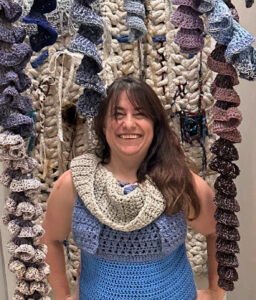
 Hi, I’m Kathryn.
I’m a writer, researcher, and community arts coordinator whose work lives at the intersection of creative practice and mental health.
For over 20 years, I’ve been asking: How does our health (mental, physical, emotional) shape the art we make? And how can we use creativity intentionally to heal ourselves and our communities?
My work combines lived experience (I came to craft as a healing practice during severe depression), academic research (Master’s degree in Psychology, year of study in Visual and Critical Studies, 100+ interviews with artists), community practice (coordinating trauma-informed arts programs in San Francisco), and writing (books, articles, blogs, and content for therapy practices).
How This Started
In my late twenties, I was navigating debilitating depression. Someone suggested I try crochet. I picked up a hook, and something shifted. Not overnight; healing never works that way. But steadily. The repetitive motion. The tangible progress. The ability to create something beautiful even when I felt broken.
I got curious: Was this just me, or was there something here worth understanding?
So I started researching. Reading. Talking to other crafters. What I found was that I wasn’t alone. Thousands of people were using craft as therapy, often without realizing that’s what they were doing.
That curiosity led me to graduate school. To a Master’s degree in Psychological Studies from California Institute of Integral Studies, where I could formally study what I’d been experiencing. And eventually to a year of study in Visual and Critical Studies at California College of the Arts, where I deepened my understanding of how art functions in culture and community.
But even before grad school, I was writing. I started blogging about crochet and mental health in 2011. The response was immediate and overwhelming. People shared their own stories of using craft to manage anxiety, process grief, cope with chronic pain, survive trauma. I realized I was documenting something important, something that wasn’t being taken seriously in either the craft world or the mental health field.
What I Do Now
One of my early books, Crochet Saved My Life (2012), documented the mental and physical health benefits of crochet. It’s been cited in peer-reviewed research and used by therapists in their practice. People still email me about it, telling me it helped them understand their own relationship with making.
Hook to Heal (2015) took that further, offering 100 original crochet exercises designed for specific psychological and emotional goals. It’s been used in substance rehabilitation programs, prisons, and therapeutic settings. A social worker once told me she keeps copies to give to clients who need something concrete to do with their hands while processing difficult emotions.
My most recent book, The Artist’s Mind (Schiffer, 2023), examines the creative lives and mental health of famous artists: Leonora Carrington, Vincent van Gogh, Frida Kahlo, and others. It’s about breaking down the binary of “tortured artist” versus “art is always therapeutic” and instead exploring the nuances. Because the truth is always more complex and more interesting than the stereotype.
Over the past decade, I’ve conducted 100+ in-depth qualitative interviews with artists about how their health impacts their creative work. From those conversations, I developed a six-part framework that maps the relationship between health and creativity across process, medium, content, productivity, identity, and sustainability.
I also created the Visual Interview methodology, an alternative research approach for people who aren’t comfortable with verbal or written formats. Participants respond through images, symbols, and mixed media. It’s more accessible, honors non-verbal communication, and allows for deeper reflection without retraumatization. I developed this after realizing that some of the most insightful responses I was getting weren’t coming through words at all.
I coordinate community programs.
In 2023, I co-founded In My Fluffy Pajamas with Iranian-born artist Badri Valian. It’s a series of trauma-informed workshops that help participants verbalize and visualize their experiences of immigration, displacement, and resilience through textile art, mapmaking, and storytelling.
We’ve worked with the Chinese Culture Center, Mission Cultural Center for Latino Arts, Asian Pacific Islander Cultural Center, and 41Ross Gallery. We’ve facilitated multilingual workshops (Mandarin, Spanish, Farsi) and engaged 10,000+ people at public events.
This work has been supported by over $45,000 in grants from the San Francisco Arts Commission, Asian Pacific Islander Cultural Center, and Center for Art and Public Life.
What I love most about this work is watching people discover that their stories matter. That their experiences of displacement aren’t just personal struggles but part of larger cultural narratives. That making something with their hands can help them process what words can’t capture.
Before that, I founded Mandalas for Marinke (2015 to 2018), a global collaborative crochet project that raised awareness about depression and suicide. We received 1,000+ mandala contributions from 300+ makers worldwide and held exhibitions with healing circles where people could sit together, share stories, and process grief collectively.
This project emerged from my own grief after learning about the suicide of Wink, a Dutch crochet designer I’d never met but whose work I admired. I wanted to create space for the crochet community to acknowledge that mental health struggles exist among us, that we can talk about them, that making together can be part of healing.
I write for therapy practices and wellness organizations.
For years, I’ve been creating content for mental health practices: website copy, blog posts, newsletters. I translate complex therapeutic concepts (CBT, DBT, trauma-informed care, somatic approaches) into language that resonates with potential clients.
Currently, I manage content strategy for the Center for Mindful Psychotherapy, a network of 100+ therapists. I’ve also written for CounselingWise, Well San Francisco, Goodman Creatives, and Palo Alto Therapy.
This work uses a different part of my brain than my books or research, but it’s deeply satisfying. I’m helping therapists communicate clearly about what they do, which means I’m helping people find the support they need.
I write online.
Most of my current writing lives at Create Me Free, my Substack newsletter where I explore creative health through personal essays, artist interviews, and research. I have over 3,000 subscribers.
Substack has become my primary writing home because it allows me to write in real time about what I’m learning, to share work in progress, to have ongoing conversations with readers. It’s less polished than a book, more immediate, more alive.
What Sustains Me
I still crochet or do some other kind of creative activity (collage, photograph walks) nearly every day. It’s how I think through problems, how I process emotions, how I stay connected to my body when my mind wants to spin out into anxiety.
I’m sustained by collaboration. By working alongside Badri on In My Fluffy Pajamas. By conversations with artists who trust me with their stories. By therapists who use my books in their practice. By readers who email to tell me something I wrote helped them understand themselves better.
I’m sustained by San Francisco, where I’ve lived for years and built deep roots. By partnerships with organizations like the Chinese Culture Center and Mission Cultural Center for Latino Arts. By walking through different neighborhoods and seeing how many communities call this city home.
And I’m sustained by the belief that this work matters. That understanding how health and creativity intersect helps people make better choices about their lives. That creating space for difficult conversations about mental health can reduce isolation and shame. That making things together builds connections we desperately need.
What I Believe
I believe in the power of self-expression as a path to authenticity in our relationship with ourselves, with our loved ones, and with the world.
I believe that mental health challenges, trauma, and socio-economic barriers all impact creative process and productivity, and that understanding those impacts helps us make better choices about our work.
I believe in equity, accessibility, and cultural responsiveness. That’s why I work in multilingual settings, develop trauma-informed methodologies, and partner with organizations serving marginalized communities.
I believe creativity can heal, not as a cure-all, not as a replacement for therapy or medicine, but as a meaningful tool for processing emotion, building resilience, and connecting with others.
And I believe in meeting people where they are. Not everyone needs to make fine art. Sometimes healing looks like crocheting a simple square. Sometimes it looks like drawing a feeling you can’t name. Sometimes it looks like sitting in a room with strangers and making something together.